
Guide
What Is Proof of Work? Why Bitcoin Transactions Get Harder to Reverse Over Time
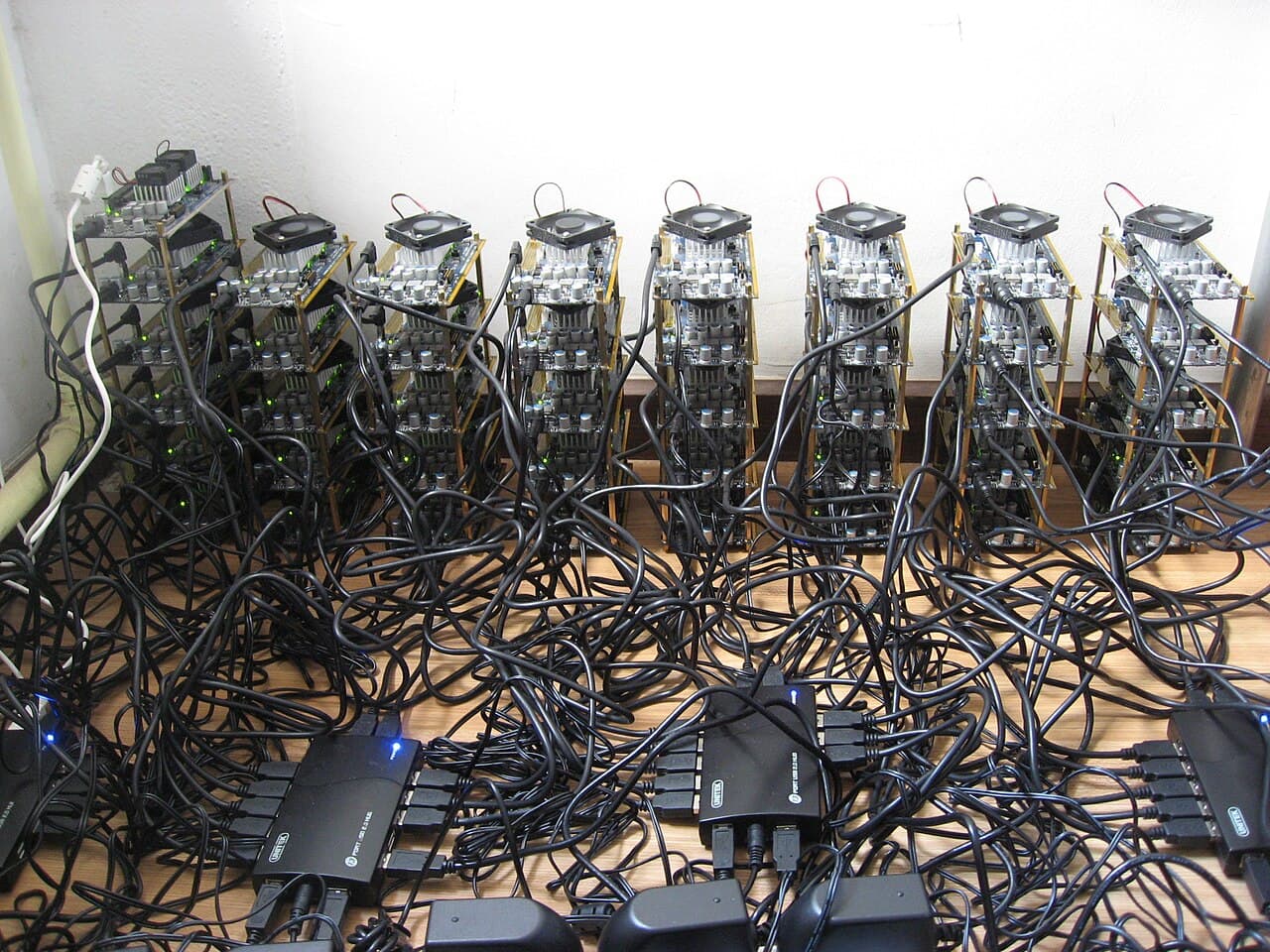
Proof of work (PoW) is Bitcoin's rule for deciding who may add the next block: only a participant who has genuinely spent computation. Rewriting an old transaction means redoing every bit of that computation from that point forward, which is why transactions become effectively irreversible as time passes.
要点
Proof of work settles disagreements by measuring work spent, not by counting votes. Each additional confirmation raises the cost of rewriting history. Nothing here is investment advice.
The problem PoW actually solves
A ledger with no administrator still needs everyone to agree on which transaction history is the real one. A plain majority vote fails immediately on the open internet, where anyone can create unlimited identities and stuff the ballot.
Bitcoin's answer was to attach voting power to computation rather than identity. Adding a block requires finding a hash that meets a target — a brute-force search with no shortcut. The electricity and hardware that search consumes is exactly what makes forging history uneconomic.
Three moving parts
1. Hashing: guess until you hit
A miner takes the block's contents plus a nonce, hashes it, and checks whether the result falls below the target. If not, change the nonce and try again. There is no clever path — only fast repeated guessing. The combined guessing speed of the whole network is its hashrate.
2. Difficulty adjustment: the automatic throttle
As more machines join, blocks would arrive too quickly. Every 2,016 blocks Bitcoin recalculates the target so that blocks return to roughly ten-minute spacing. See difficulty adjustment.
3. Most-work chain wins
When the chain forks, nodes treat the branch with the greatest cumulative work as valid. Note what this is not: not first-come-first-served, and not a headcount. The history with the most computation invested in it is the history that counts.
Why confirmations mean safety
To undo a payment you received, an attacker must build an alternative history without it and then make that history longer than the current one. Every block mined on top of your transaction adds to the amount of work they would have to out-run.
So a confirmation count is not really a waiting time. It is a price tag on reversing your transaction. See what a Bitcoin confirmation is.
What a 51% attack can and cannot do
An attacker holding a majority of hashrate can mainly do two things: reverse their own recent transactions (double spending) and censor specific transactions by refusing to include them.
What they cannot do is move other people's coins. Spending requires a signature from a private key, which has nothing to do with hashrate. They also cannot raise the 21 million supply cap. See what a 51% attack is and what double spending is.
Proof of work versus proof of stake
PoW makes cheating uneconomic using external costs — electricity and hardware. Proof of stake (PoS) does the same job with internal costs, by confiscating the deposited coins of a misbehaving validator. Ethereum moved from PoW to PoS in 2022; Bitcoin has kept PoW.
- PoW: entry requires physical hardware and power; attack cost is anchored in the outside economy; energy use is high.
- PoS: energy use is low; attack cost depends on the price of the coin itself; the initial distribution has longer-lasting effects.
Which is better depends on which assumptions you start from, so this site does not declare a winner. See also Bitcoin vs Ethereum.
The energy argument, stated fairly
PoW's power consumption draws steady criticism. The design point worth understanding first is that the energy spend is the security budget. If a chain is cheap to defend, it is cheap to attack.
That said, the questions of what the energy mix looks like — how much comes from surplus power or flared gas — and whether comparable security could be bought for less energy remain legitimately open. See Bitcoin and energy.
In short
Proof of work is not a mechanism for reaching agreement quickly. It is a mechanism for making reversal expensive. That is the reason waiting for more confirmations on a large payment is a real security decision rather than a superstition. For the wider picture see how Bitcoin works and the Bitcoin whitepaper.
Sources
FAQ
- What is proof of work in Bitcoin?
- It is the rule that only a participant who has actually spent computation may add the next block. Nodes treat the forked chain with the greatest cumulative work as the valid one, so rewriting history requires redoing that computation.
- Why do more confirmations make a transaction safer?
- Reversing a transaction requires building an alternative chain without it and making that chain longer than the current one. Each block added on top increases the amount of computation an attacker would need to out-run, and therefore the cost.
- Can a 51% attack steal my bitcoin?
- No. Spending coins requires a signature from the owner's private key, which hashrate cannot produce. A majority attacker can mainly reverse their own recent transactions and censor specific transactions from being included in blocks.
- How is proof of stake different from proof of work?
- Proof of work deters attacks with external costs — electricity and hardware — while proof of stake uses internal costs by slashing a validator's deposited coins. Ethereum switched to proof of stake in 2022; Bitcoin still uses proof of work.
This article is informational only and is not financial, investment, or trading advice. Prices are reference snapshots and may be outdated. Always do your own research.