Guide
What Is Bitcoin's Hash Rate? EH/s Explained and Why "Higher Means Safer"
The Bottom Line
Bitcoin's hash rate is the total number of calculations (hash computations) that miners around the world attempt across the entire network every second, expressed in EH/s (exahashes per second = 10^18 hashes per second). When headlines report that "hash rate hit a new all-time high," it means that a greater amount of computing power (mining hardware and electricity) is now securing Bitcoin. The basic takeaway is that this raises the cost of tampering — especially a 51% attack — and makes the network more robust. That said, there is no direct cause-and-effect where "if hash rate goes up, so does the price."
Key points of this article
- Hash rate = the combined computing power of the entire network. The unit is EH/s (in recent years reaching the scale of 1,000 EH/s = 1 ZH/s).
- The higher it is, the more the hardware and electricity cost of mounting a 51% attack skyrockets, so it serves as a gauge of security.
- In step with rises and falls in hash rate, the mining difficulty auto-adjusts roughly every two weeks.
- The correlation with price is widely misunderstood. There are periods where they move together over the long run, but there is no short-term causal link.
What is Hash Rate (Definition and EH/s)
Bitcoin mining is a "brute-force" task of repeating an enormous number of calculations until a hash value that meets the required conditions is found. Hash rate is the metric that shows how many of these calculations the entire network is attempting per second.
Because the numbers involved are so large, the unit is expressed with prefixes.
| Unit | Name | Hashes per second |
|---|---|---|
| TH/s | Terahash | 10^12 |
| PH/s | Petahash | 10^15 |
| EH/s | Exahash | 10^18 |
| ZH/s | Zettahash | 10^21 (= 1,000 EH/s) |
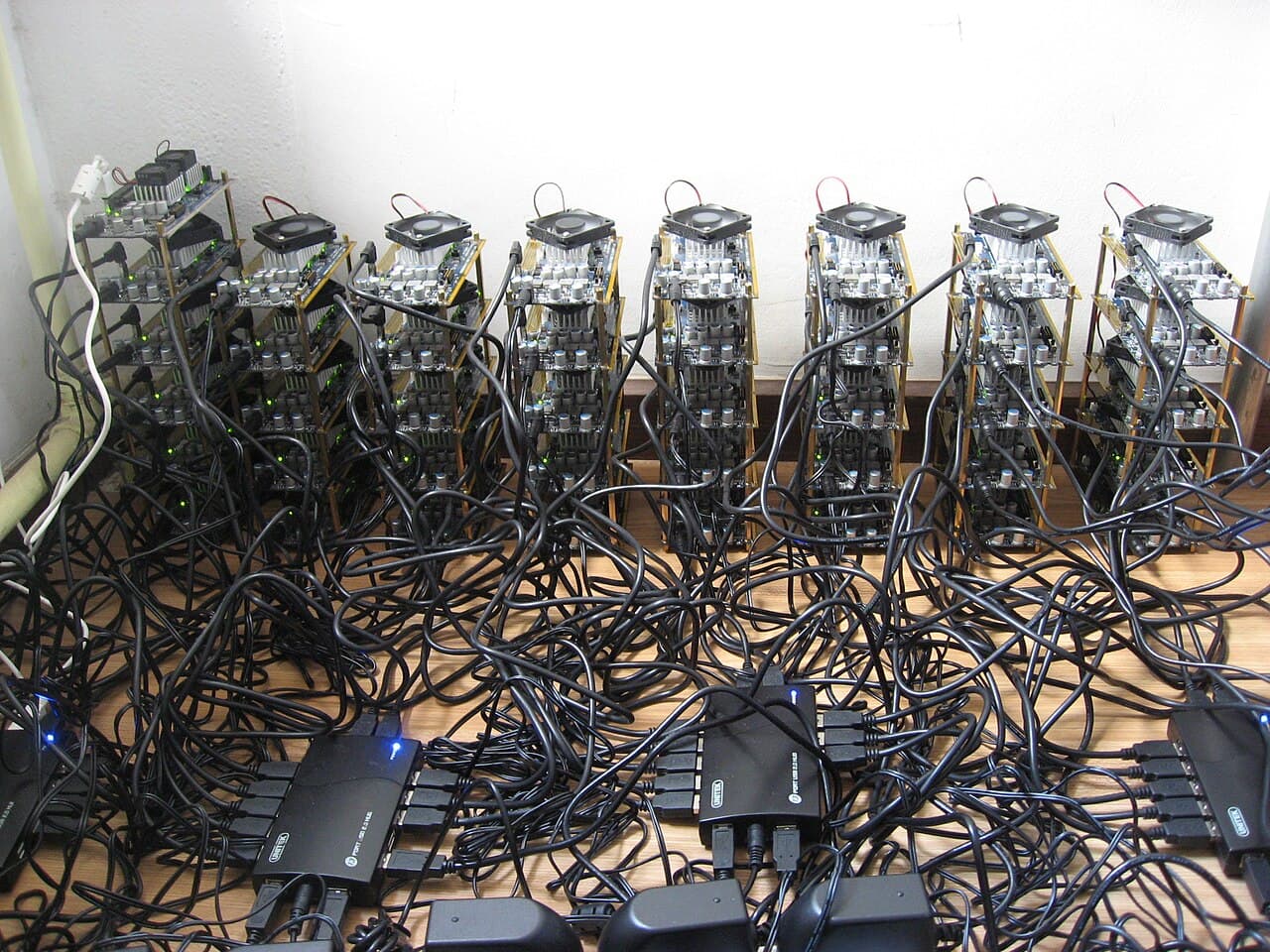
In recent years Bitcoin has hovered on the scale of several hundred to 1,000 EH/s (= 1 ZH/s), and in autumn 2025 new all-time highs above 1,100 EH/s were reported on several occasions (the latest figures fluctuate, so check official data). While a personal PC runs at roughly a few million hashes per second (mega- to giga-range), the entire network operates at a scale thousands of trillions of times greater. This computation is handled by dedicated machines (ASICs); how they work is explained in detail in What is Bitcoin mining.
重要
Hash rate is an estimated value that cannot be directly observed. All that can actually be counted is "how many blocks were mined in a given period," from which the hash rate is calculated backward. As a result, the numbers vary depending on the source (various chart sites) and the aggregation window (instantaneous value versus 7-day moving average). In practice, look at the trend using a moving average rather than a single instantaneous reading.
Why Higher Means Safer (The Cost of a 51% Attack)
The most commonly discussed threat to Bitcoin is the 51% attack. This refers to an attack in which a malicious actor seizes a majority (more than 50%) of the network's total computing power and attempts to reverse transactions (double-spending) and the like.
This is where hash rate matters. The higher the network's total hash rate, the more astronomical the number of mining machines, the electricity, and the data centers required to secure a majority of it. To seize a majority of a network on the scale of 1,000 EH/s, an attacker would have to newly assemble hardware rivaling that of today's largest mining companies and keep paying enormous electricity bills — a level that is realistically almost impossible.
Even more important is the economic incentive. Even if an attacker poured in a vast sum and managed to seize a majority, the moment the attack came to light, trust in Bitcoin and its price would collapse, wiping out the value of the assets the attacker holds and mines. "The attack costs a fortune, and even if it succeeds it isn't worth it" — this double wall, built by a high hash rate, is the essence of Bitcoin's security.
The Link with Difficulty Adjustment
No discussion of hash rate is complete without difficulty adjustment. Bitcoin automatically reviews mining difficulty roughly every two weeks (precisely, every 2,016 blocks), adjusting it so that the average interval between blocks stays at 10 minutes.
- More miners join and hash rate rises → blocks are found faster → at the next adjustment, difficulty is revised upward to bring the interval back to 10 minutes.
- Miners withdraw and hash rate falls → blocks come more slowly → difficulty is revised downward.
In other words, hash rate and difficulty move as two sides of the same coin. In 2025, a surge in hash rate pushed difficulty to consecutive record highs, while conversely in early 2026 a cold snap forced Texas miners to pause temporarily, and both hash rate and difficulty fell sharply for a time. The details of this self-adjusting mechanism are covered in What is difficulty adjustment.
The Relationship with Price (Correcting a Common Misconception)
The most common misconception is the causal claim that "if hash rate rises, price rises too." To put it plainly: there is no short-term causal relationship.
If anything, the logic runs in the opposite direction. The reality is closer to this sequence: Bitcoin's price rises → mining profitability improves → new miners enter → and, with a lag of several weeks to several months, hash rate rises. In other words, hash rate is less a "cause" of price and more a "trailing result," and there are frequent phases where price and hash rate move in opposite directions (for example, price stays flat while hash rate sets a new record). How mining profitability is determined is covered in detail in Is Bitcoin mining profitable.
Snap judgments like "hash rate is at a record high, so it's a good time to buy" are to be avoided. Hash rate is a metric for measuring the health and security of the network — not a tool for predicting price.
注意
This article is educational commentary, not investment advice. Hash rate can serve as a gauge of security, but it does not guarantee future prices or profits, and cryptocurrency prices are highly volatile. The figures in this text are approximate as of the time of writing; always verify the latest actual figures against official data such as CoinWarz or mempool.space. Make investment decisions at your own responsibility.
Frequently Asked Questions
Q. How do you read the hash rate unit "EH/s"? A. It is read "exahashes per second" and means 10^18 (one quintillion) hash computations per second. 1,000 EH/s = 1 ZH/s (zettahashes per second).
Q. Is Bitcoin in danger if the hash rate drops? A. Temporary drops (such as shutdowns caused by bad weather) happen often and are not necessarily an immediate danger. If the drop persists, the difficulty adjustment about two weeks later lowers the difficulty, profitability recovers, and miners re-enter — a self-healing mechanism.
Q. If hash rate is at an all-time high, will the price go up too? A. There is no direct causal link. If anything, a price rise comes first, and hash rate tends to rise afterward as profitability improves. It's best understood as a metric of security.
Q. Can anyone check the hash rate? A. Yes. CoinWarz, mempool.space, bitinfocharts and others publish charts for free. Note, however, that because it is an estimate, the figures differ somewhat depending on the source and the aggregation window.
Sources
Sources
FAQ
- How do you read the hash rate unit "EH/s"?
- It is read "exahashes per second" and means 10^18 (one quintillion) hash computations per second. 1,000 EH/s = 1 ZH/s (zettahashes per second).
- Is Bitcoin in danger if the hash rate drops?
- Temporary drops happen often and are not necessarily an immediate danger. If the drop persists, the difficulty adjustment about two weeks later lowers the difficulty, profitability recovers, and miners re-enter — a self-healing mechanism.
- If hash rate is at an all-time high, will the price go up too?
- There is no direct causal link. If anything, a price rise comes first, and hash rate tends to rise afterward as profitability improves. It's best understood as a metric of security.
- Can anyone check the hash rate?
- Yes. CoinWarz, mempool.space, bitinfocharts and others publish charts for free. Note, however, that because it is an estimate, the figures differ somewhat depending on the source and the aggregation window.
This article is informational only and is not financial, investment, or trading advice. Prices are reference snapshots and may be outdated. Always do your own research.